


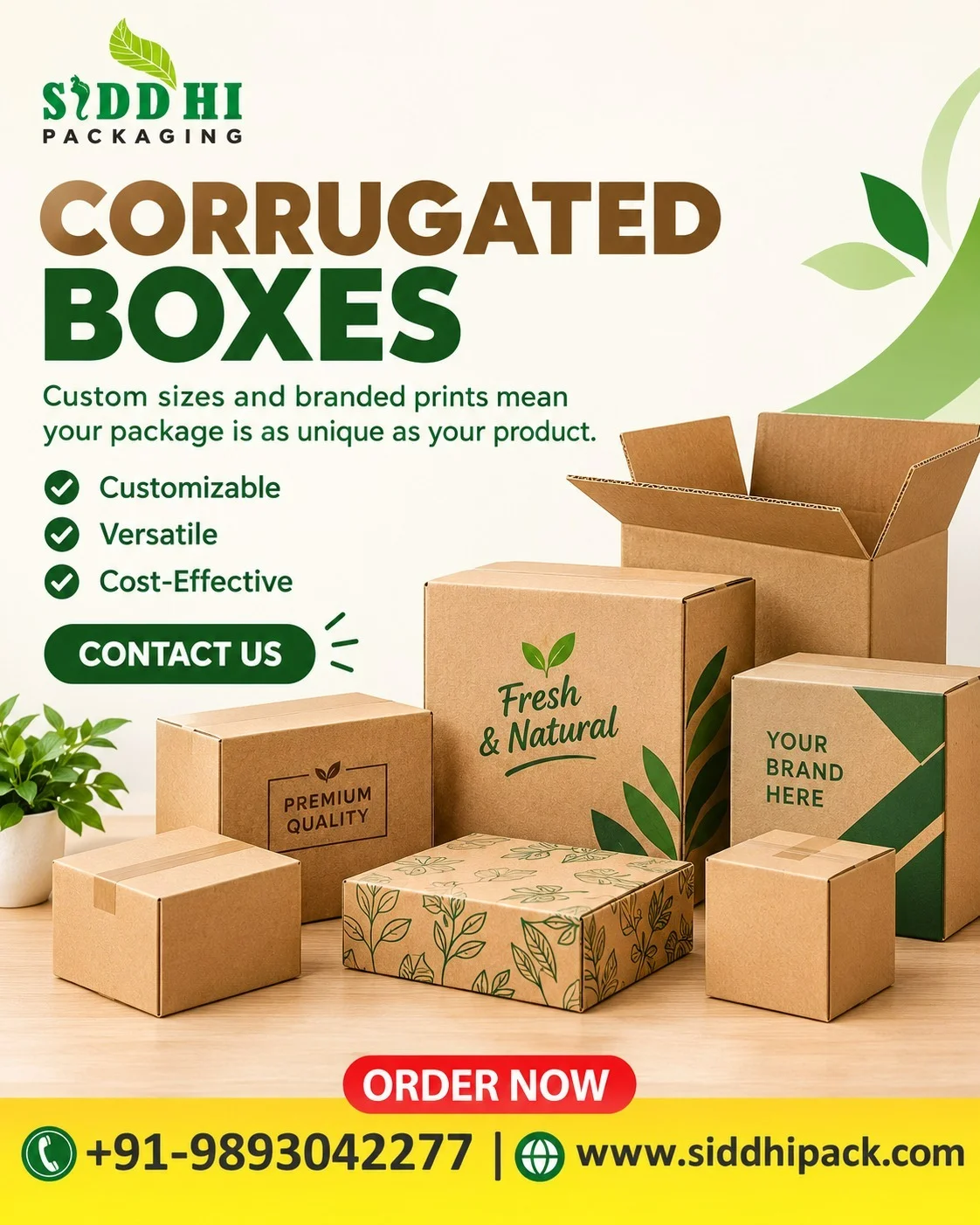
A glass jar fits neatly in the sample box. Then you slip a protective pad underneath it, and the top of the carton bulges when you tape it shut. Catch that at the packing table and you can adjust the box depth before the full batch arrives. If you’re ordering custom corrugated boxes in Indore, start by packing one product exactly as it will go out to a customer. That first trial can tell you more about the fit than a set of measurements on its own.
When you speak with Siddhi Packaging, share what you’re packing, how many pieces go into each carton, and how the finished parcel will be handled. If you’re replacing an existing box, bring one along and point out where it gives you trouble. A corner that keeps getting crushed or a flap that’s awkward to tape gives you something specific to improve.
Custom corrugated boxes are cartons made to suit a particular product or packing process. Corrugated board is made with one or more wavy paper layers held between flat liners. You can specify the box dimensions, board grade, style, and print based on what the carton has to do. A brand selling jars online might need room for dividers, while a clothing retailer might want a box shallow enough to keep folded garments in place.
When sharing a size, label it as the internal box dimensions if it describes the space you need inside. If the packed carton also has to fit a shelf, a delivery crate, or another shipping box, give the maximum outside dimensions separately.
Set out everything that goes into one carton. That includes the product, any sleeves or inserts, and anything else you ship with it. If you send two jars together, position them as they’ll sit with the divider in place and measure that arrangement. For products you sell in several sizes, test the smallest and largest sizes you expect to use with the same carton. That will show where you need more clearance or where there’s too much room for the contents to move.
A 3-ply corrugated box has one fluted layer between two liners. A 5-ply corrugated box has two fluted layers and three liners. Use the packed weight, the way the boxes will be stacked, and the number of times they’ll be moved to discuss which board grade to try. Two cartons of the same size can face very different demands. A box of machine parts that spends several days under other cartons in a warehouse needs to be assessed with that stacking load in mind.
A regular slotted carton has outer flaps that meet in the middle for taping. It’s a practical style to consider when several people pack orders at once and the team already uses tape dispensers. A die-cut corrugated box can have shaped panels or tabs that fold into place. If you’re considering a die-cut mailer for a subscription kit, have someone assemble a few samples at their usual pace. You’ll see how easy it is to fold the tabs and how much room there is to place the items inside.
Print the details that serve a purpose at delivery or in the warehouse. For a retail parcel, that could be a logo where the customer will see it when they pick up the box. For a wholesale carton, a large product code on the side can help staff identify stock without opening it. Think about which panel will face out once the boxes are stacked.
Review a proof on the board colour you intend to use. Check where the tape, fold lines, and shipping label will sit. A logo can look fine on screen and end up partly covered by the courier label when someone packs the first order. If you’re weighing a single-colour logo against artwork with several colours, request a price for each version at the same quantity.
When comparing quotes for custom corrugated boxes in Indore, give each supplier the same details. A unit price is easier to compare when you can see exactly which box, print, and order size it covers.
Check whether the quote lists any charges for the sample, a cutting die, print setup, or delivery. If you expect to place repeat orders, ask which of those charges would apply again.
For a delivery to a workshop in Palda or a warehouse near Dewas Naka, give the destination PIN code and a receiving window when you request the quote. Ask how much time to allow for sample approval, production, and delivery. If your shipment has a fixed dispatch date, leave enough time for your team to try the approved box with the real product and inspect the first delivery before packing starts.
Yes, if each product fits securely in the packed carton. Try each product in the box with its own insert or cushioning. If you need a lot of extra filler for one item, compare the packing time and material cost with the cost of keeping a second carton size in stock.
Yes. Branded tape or a label can work well if you need the same plain carton for several product lines. Try the label on the actual board first and check that it adheres to the surface you’ll use. If you use the same cartons for retail and wholesale, different label colours can help your team distinguish the orders after packing.
The minimum can vary by size, box style, print requirements, and supplier. If you need two sizes, ask for the minimum quantity for each one. Request prices for your current requirement and the next quantity tier if you expect the order to grow.
Store flat-packed cartons in a dry area, off the floor, and keep different sizes labelled. Put frequently used sizes within easy reach of the packing table. For printed cartons, mark the artwork version on the bundle so staff can identify the right stock at a glance.
Keep an approved sample or its specification sheet, the supplier’s box reference, and the final artwork if the box is printed. If the product or its inserts change before the next order, pack a trial carton again to check whether the existing dimensions still work.
Contact Siddhi Packaging for a quote on custom corrugated packaging in Indore. Share your product dimensions, packed weight, and order quantity. If you have an existing carton you’d like to improve, tell us what happens during packing or delivery so we can discuss the right size, board, and finish for your next run.
| Tags: | #Custom Corrugated Boxes in Indore |


