


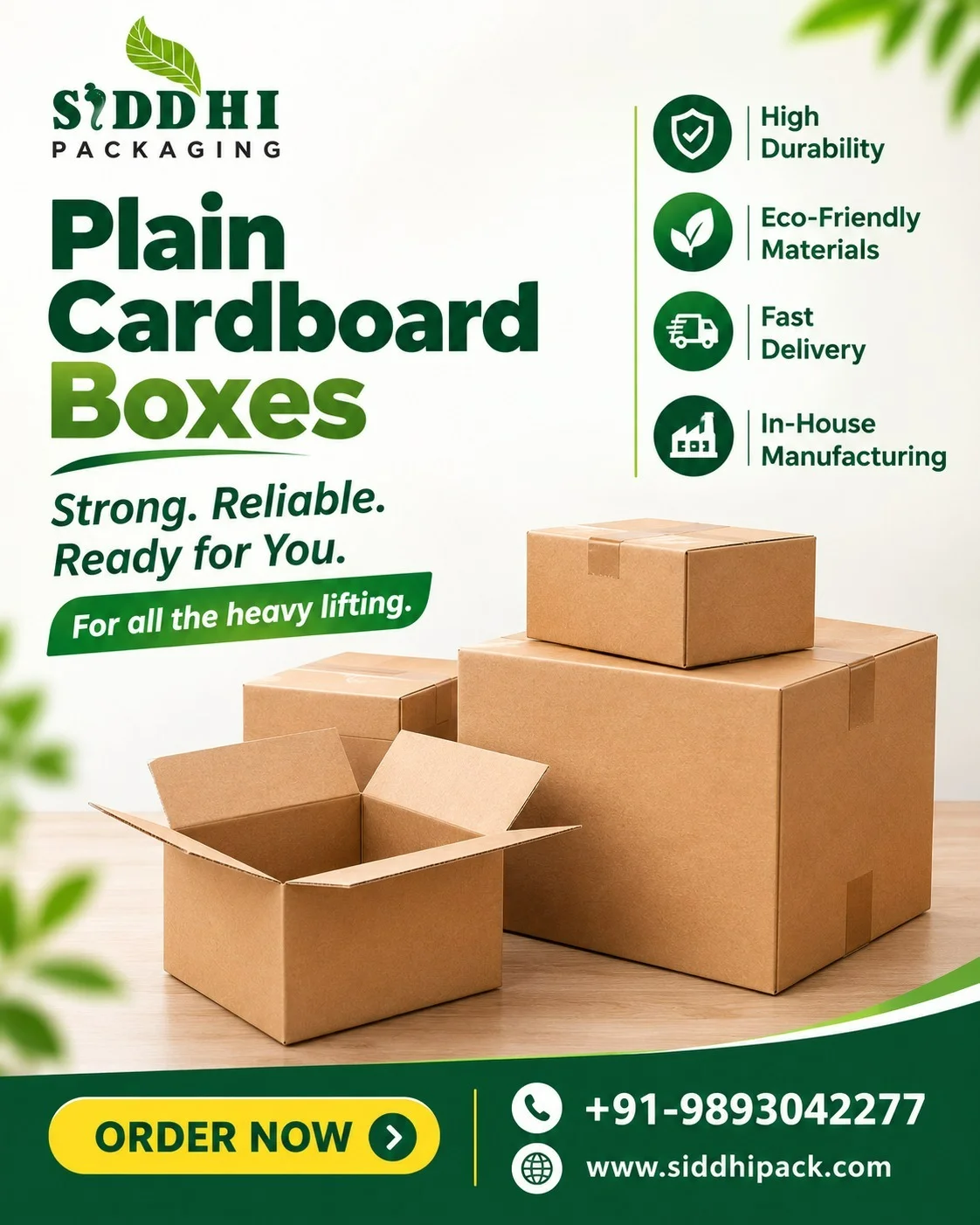
Plain Cardboard Boxes in Indore offer businesses an unprinted packaging option for organising goods, preparing orders, and moving products between locations. Choosing a suitable box involves matching its dimensions, board construction, and strength to the packed product and its handling conditions.
At the packing table, small details quickly become important. Extra space means more filling material. An awkward size slows down packing. A poorly matched box can make stacking difficult. Getting the specification right helps the rest of the dispatch process work more smoothly.
With in-house manufacturing, Siddhi Packaging offers plain cardboard packaging for businesses looking to discuss their storage, transport, and bulk packing requirements.
Plain cardboard boxes have an unprinted outer surface that can be labelled or marked according to the buyer’s needs. Their straightforward appearance makes them adaptable to different products and dispatch arrangements.
The word cardboard covers several paper-based materials. Many shipping cartons use corrugated board, which combines flat paper layers with a fluted layer between them. Buyers should confirm the actual material and construction when requesting a quotation.
Two brown boxes of the same size may differ in board quality, construction, and suitability for a particular load. Comparing these details helps buyers choose packaging that fits the job.
Unprinted boxes can serve several purposes when selected for the products being packed.
Common applications include:
A box used on a storage shelf may face different demands from one travelling through several delivery points. Explain the full journey when discussing your packaging requirements.
Measure the product as it will actually be packed. Include wrapping, separators, inserts, or any accessories that travel with it.
Ask whether the quoted dimensions are internal or external. This matters when the item fits closely or when several smaller boxes must fit into a larger carton.
Custom-size cardboard boxes may be worth discussing when standard sizes leave excessive empty space or do not accommodate the product comfortably. Compare the proposed fit with a physical sample before finalising an order.
The weight of the complete package includes the product, protective material, and accessories. Give this information to the manufacturer so the proposed construction can be assessed.
Also explain how the weight is distributed. A compact metal component and a carton full of lightweight garments place different demands on packaging, even when their outer dimensions are similar.
For heavy goods, ask for a suitable specification and relevant performance information. Detailed specifications make quotations easier to compare than a general description such as “strong box.”
Tell the supplier whether cartons will be stacked in a warehouse, moved individually, or transported on pallets. Mention the likely storage duration and any handling concerns.
Box performance depends on several factors. Board quality, construction, dimensions, moisture exposure, and packing arrangements all matter.
For demanding applications, discuss appropriate packaging tests and acceptance criteria before committing to a large quantity.
A carton needs a suitable closing method. Check how its flaps meet and whether the proposed tape or other closure works with the packed load.
For fragile products, discuss cushioning and separation. Cardboard packaging for shipping should be considered as a complete arrangement, including what goes inside the box.
A correctly sized outer carton can still require inserts or padding to prevent movement and contact between delicate items.
Plain packaging gives businesses flexibility in how they identify orders. Labels, handling instructions, product codes, and dispatch details can be added as required.
This can be useful when one box size serves several product lines. Staff can identify each package through its label while using a consistent carton specification.
Keep markings clear and easy to locate. When packages pass through several hands, a readable label helps people identify the contents or destination without opening the box.
If branded presentation becomes necessary later, ask about the available printing or labelling options and their effect on quantities and cost.
A repeat order works best when everyone refers to the same specification. Keep a record of the approved size, board construction, box style, and packaging details.
Before requesting a bulk quotation, prepare:
When comparing quotations, check what each price includes. Transport, taxes, sample charges, and optional additions may affect the final amount.
Businesses buying locally in Indore can also ask whether sample review, collection, or delivery can be arranged. Confirm these arrangements before placing an order.
A sample lets your team assess the box with the actual product. Pack it using the intended wrapping and closure, then review the fit and handling.
Notice whether packing requires unnecessary adjustments. Check that the product sits comfortably and that the carton closes without being forced out of shape.
Use this review to agree on any changes before production. For repeat orders, retain an approved sample or a clear written specification so future supplies can be compared consistently.
Paper-based packaging should be discussed in specific terms. Ask about the board composition, recycled content where relevant, and any coatings or additional materials.
Plain corrugated boxes may be reused while they remain clean, dry, and structurally sound. Inspect them before reuse, especially around corners, folds, and closure areas.
For recycling, check what your local collection service accepts. Remove or separate additional packaging materials where required.
Choosing a sensible box size can also reduce unnecessary empty space and the amount of filling needed. The aim is to use enough material for the job while maintaining suitable protection.
Store unused cartons in a clean, dry area where they are protected from water and accidental damage. Keep them organised by size so staff can select the correct carton easily.
If supplied flat, maintain a tidy stack and avoid crushing the edges. Inspect boxes that have been stored for a long period before using them for valuable or demanding shipments.
Good storage preserves the condition of the packaging you have purchased.
Plain boxes have an unprinted surface, while printed boxes carry selected graphics or information. Either option needs a suitable material specification. Printing alone does not determine how much weight a carton can support.
They can be when the construction and packing arrangement are appropriate. Share the total weight, product shape, stacking conditions, and transport requirements. Ask the manufacturer to recommend a specification and explain how its suitability will be assessed.
Ask about standard dimensions and custom-size availability. Provide the required internal measurements, product details, and quantity. A sample helps confirm whether the proposed size works before a bulk order is approved.
Pricing depends on dimensions, material specification, box style, quantity, and any additional requirements. Delivery arrangements can also affect the total. Request a quotation based on a clearly defined specification for a useful comparison.
Often, yes. The appropriate protection depends on the item and its journey. Discuss cushioning, dividers, or fitted inserts where needed, then review the complete packed sample, including the outer carton and internal protection.
The right Plain Cardboard Boxes in Indore should fit your products, suit your handling process, and support an organised dispatch routine.
Contact Siddhi Packaging to discuss dimensions, quantities, material requirements, and current pricing. Call with your product details and ask about suitable packaging options.
Contact Us and Get a Free Quote Today for your business packing requirements.
| Tags: | #Plain Cardboard Boxes in Indore |


